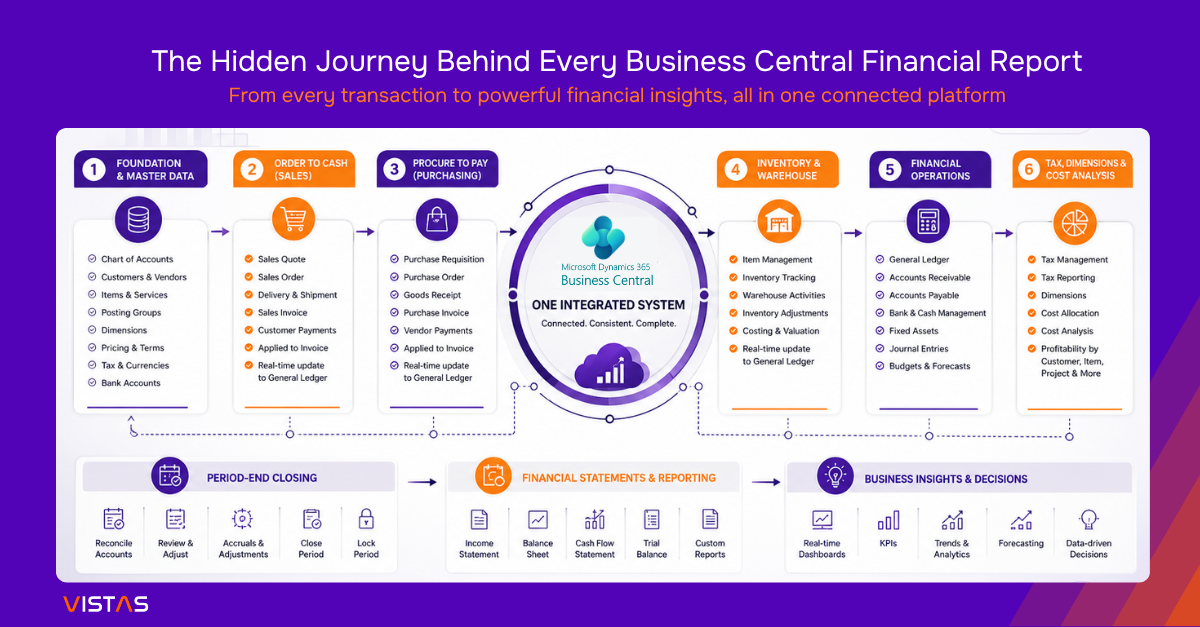
The Hidden Journey Behind Every Business Central Financial Report
When leadership opens a financial report in Microsoft Dynamics 365 Business Central, they see numbers.
Revenue. Expenses. Receivables. Payables. Inventory. Cash.
But those numbers didn’t begin with the financial statements.
They started much earlier, with the everyday activities happening across the business.
A customer order. A shipment. A purchase. An invoice. An inventory movement. A payment.
Each transaction becomes part of a much larger financial story.
And that is one of the most important things to understand about Business Central.
The Financial Report Is the Destination. Not the Starting Point
It’s easy to think of Finance as the final stop where transactions eventually become accounting data.
In an integrated ERP environment, the relationship is much closer.
A sales order can lead to fulfillment, invoicing, customer receivables, inventory activity, and financial entries.
A purchase can connect procurement, receiving, inventory, accounts payable, and cash requirements.
The value isn’t simply that these processes are digital.
The value is that they are connected.
That connection helps organizations reduce the gaps between what the business does and what Finance sees.
It Starts with the Rules Behind the Transaction
Before the first order is entered, Business Central already needs to understand how the organization operates.
Which accounts should be used?
How should customers and vendors be classified?
How should inventory be posted?
Which dimensions should be captured?
How should taxes and payment terms be handled?
These may look like configuration details, but they directly influence the quality of the financial information produced later.
Automation can execute a process consistently, but only when the underlying rules and data are designed correctly.
That’s why successful Business Central implementation is about more than turning features on.
It starts with understanding the business.
The General Ledger Doesn’t Tell the Whole Story
The General Ledger is central to financial management, but a financial figure shouldn’t be treated as an isolated number.
When Finance sees an amount in a report, they may need to understand:
- Where did it come from?
- What transaction created it?
- Which customer, vendor, item, or account was involved?
- Which dimensions were applied?
- What posting configuration determined the accounting treatment?
This is where traceability becomes valuable.
Instead of simply seeing what was recorded, users can investigate why it was recorded and where it originated.
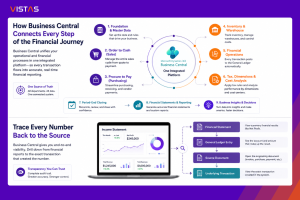
From financial results back to the underlying business activity, traceability helps users understand the data behind the numbers.
From Transactions to Business Visibility
The ultimate value isn’t the transaction itself.
It’s what the organization can understand from the information created by those transactions.
Sales activity can become revenue information.
Purchasing can become cost information.
Inventory movements can become valuation and profitability information.
Payments can become cash-flow information.
Dimensions can provide context around where and why money is being spent.
When these pieces come together, leadership gains a clearer view of business performance.
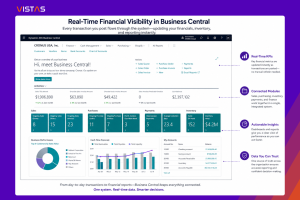
Business Central brings operational and financial information together to support visibility, analysis, and better business decisions.
The journey becomes:
Business Activity → Connected Data → Financial Information → Analysis → Decision-Making
And the closer that connection is, the more valuable the ERP becomes.
Good Data Doesn’t Happen by Accident
Business Central can connect business processes, but technology alone doesn’t guarantee accurate information.
Data quality depends on:
Configuration: Are financial and operational rules set up correctly?
Master Data: Are customers, vendors, items, and other records maintained consistently?
Process Design: Do workflows reflect how the business operates?
User Adoption: Are employees entering the right information at the right stage?
Reporting: Are organizations capturing information management needs?
These elements work together.
That’s why ERP implementation should be viewed as a business process initiative supported by technology, rather than simply software deployment.
The Bigger Picture
Organizations don’t invest in Business Central simply to process more orders or invoices.
The bigger goal is to create a stronger connection between:
What the business does → What the business knows → What the business decides
When that connection works well, Finance can spend less time piecing together information and more time analyzing it.
Operations gain better visibility into the financial impact of their activities.
Leadership gets a clearer picture of performance.
And the organization has a stronger foundation for making informed decisions.
What This Means for a Business Central Implementation
The most important questions aren’t always:
“Can Business Central process this transaction?”
Instead, organizations should also ask:
“What happens to the information after the transaction is posted?”
Where does it go?
Which financial records do it affect?
What operational information does it update?
How will Finance analyze it?
And ultimately:
What decision can the business make from that information?
Those questions move an implementation from feature configuration toward business transformation.
At VISTAS Cloud, we believe getting the most from Business Central starts with understanding this bigger picture, not just the individual transactions.
Because an ERP system becomes truly valuable when it connects what the business does with what the business needs to know.
Ready to Get More from Business Central?
Whether you’re planning a Business Central implementation, improving the existing environment, or looking for ways to connect your operational and financial processes, VISTAS Cloud can help.
[TALK TO A BUSINESS CENTRAL EXPERT →]
What part of your Business Central environment has the biggest impact on financial data quality?
Configuration, master data, process design, user adoption, or reporting?
Share your perspective in the comments.