Why CPA-Led Business Central Implementation Matters
Microsoft Dynamics 365 Business Central Implementation is not just a technology project.
It is a financial and operational transformation, essentially.
Decisions made during implementation impact your chart of accounts, general ledger, accounts payable and receivable, inventory valuation, financial reporting, dimensions, controls, approvals and management reporting.
That is why VISTAS Cloud takes a different approach.
Business Central implementations at VISTAS Central are CPA-led—bringing financial and accounting expertise into the implementation process from the beginning.
Instead of focusing only on configuring software, the goal is to build a Business Central environment around how financial information should flow through your organization.
An ERP Implementation Is Also an Accounting Implementation
A new ERP affects almost every financial process in a business.
Consider what happens when an organization moves from QuickBooks, Dynamics GP, Sage, NetSuite, SAP Business One, or another legacy accounting system to Microsoft Dynamics 365 Business Central.
You aren’t simply moving data from one database to another.
You are making decisions about:
- How the chart of accounts should be structured
- How customers and vendors should be organized
- How transactions should post to the general ledger
- How departments, locations, projects, and business units should be tracked
- How inventory should flow through financial reporting
- How approvals and financial controls should work
- What management needs to see in financial reports
- How historical and opening data should be migrated
- How the system should support the company’s future growth
These are technology questions—but they are also accounting questions.
That is the thinking behind VISTAS Central’s CPA-led implementation model.
What Does CPA-Led Business Central Implementation Mean?
CPA-led implementation means approaching Business Central from the perspective of the business and its financial processes—not simply from the perspective of software configuration.
A traditional technology-first implementation may begin with:
“How should we configure Business Central?”
A CPA-led implementation begins with a broader question:
“How should your business and financial processes work—and how should Business Central support them?”
That distinction can influence everything from the chart of accounts and dimensions to reporting, controls, workflows, inventory, and data migration.
The objective is not simply to get Business Central running.
It is to create a system that produces useful, reliable financial and operational information for the people running the business.
Why Financial Expertise Matters During Business Central Implementation
1. Building the Right Financial Foundation
The financial structure established during implementation can remain with a company for years.
Business Central needs to reflect how the organization actually operates while also providing management with the information needed to understand performance.
That includes decisions involving the general ledger, posting groups, dimensions, departments, locations, reporting structures, and other financial configurations.
A CPA-led approach puts these decisions at the center of implementation rather than treating accounting configuration as another item on a technical checklist.
2. Better Management Reporting Starts with Better Setup
One reason businesses move to an ERP is to get better information.
But sophisticated software cannot compensate for poorly structured financial data.
If accounts, dimensions, posting structures, or operational data are configured incorrectly, management reporting can become unnecessarily difficult.
VISTAS Central’s CPA-led approach considers reporting requirements while the ERP is being designed.
The question isn’t only:
“Can Business Central record this transaction?”
It is also:
“Will this transaction ultimately give management the financial information it needs?”
That is a much more valuable question.
3. Connecting Operations to Finance
Business Central isn’t simply accounting software.
Sales, purchasing, inventory, warehousing, projects and other operational activities all have financial consequences sooner or later.
For example, decisions to purchase impact payables and cash flow. Inventory transactions impact valuation and cost of goods sold. The sales activity affects revenue and receivables.
Thus a good Business Central implementation needs to understand both sides of the equation:
what happened operationally and how it should be reflected financially.
CPA-led implementation helps keep that connection in focus.
Moving Beyond QuickBooks
QuickBooks is a great accounting platform for smaller organizations.
But as a company grows, their needs can get more complex.
The business may need tighter inventory management, more financial dimensions, more sophisticated approvals, better reporting, multiple departments or locations and a closer integration between accounting and operations.
At that point, moving to Microsoft Dynamics 365 Business Central can be more than a software upgrade.
“It can be an opportunity to rethink the way the company’s financial infrastructure should work.”
Rather than simply recreating the existing QuickBooks environment inside a larger ERP, VISTAS Central’s CPA-led approach can help organizations think through how their financial processes should be structured for the next stage of growth.
Migrating from Dynamics GP and Legacy ERP Systems
Organizations moving from Microsoft Dynamics GP or another legacy ERP face a different challenge.
Their existing system may contain years—or decades—of accumulated processes, accounts, reports, workarounds, and customizations.
The easiest approach might seem to be recreating everything exactly as it exists.
But an ERP migration also creates an opportunity to ask:
Do we still need to do things this way?
A CPA-led Business Central implementation can examine the financial logic behind existing processes before simply reproducing them in the new environment.
Some processes may need to remain. Others may be simplified, redesigned, or replaced with capabilities already available in Business Central.
The goal should be modernization—not simply moving legacy complexity into the cloud.
CPA Expertise Plus Microsoft Business Central Expertise
A successful ERP implementation cannot rely on accounting expertise alone.
It also requires deep understanding of Microsoft Dynamics 365 Business Central.
That is where the VISTAS Central model becomes especially relevant.
The implementation brings together financial expertise and Business Central expertise so that accounting requirements can be translated into a properly configured ERP environment.
The technical and financial sides of the project should not operate in isolation.
They should work together.
A Structured Path to Business Central
CPA-led implementation is the foundation, but VISTAS Central also simplifies how businesses build their Business Central solution.
The process centers around three choices:
- Choose Your Feature Packs
Select the Business Central functionality your organization requires. - Choose Your User Licenses
Match Business Central access to the roles and responsibilities of your users. - Choose Your Support Package
Determine the level of ongoing assistance your organization will need after implementation.
This allows organizations to start with the functionality they need today while retaining the ability to expand Business Central as the company grows.
From Financial Discovery to Go-Live
The implementation journey should begin before data is imported or screens are configured.
It begins with understanding the business.
What does the organization need to report?
How does revenue flow through the business?
How are purchases approved?
How is inventory managed and valued?
How does management analyze profitability?
Which processes create unnecessary manual work?
Which information does leadership struggle to obtain today?
Those questions help establish the financial and operational foundation for Business Central.
From there, the implementation can move through configuration, migration, validation, training, and ultimately go-live.
And because an ERP continues evolving after launch, VISTAS Central provides ongoing support options to help organizations continue developing their Business Central environment.
Business Central Built Around the Numbers That Matter
Companies don’t buy an ERP because they want new software.
They do an ERP because they want to run the business better.
They want greater visibility.
Better financial reporting.
More efficient operations.
Stronger processes.
Better information for decision-making.
And a platform capable of supporting future growth.
This is why the accounting foundation is so important.
VISTAS Central’s CPA-led implementation of Microsoft Dynamics 365 Business Central embeds financial thinking into the ERP project from the very beginning—helping businesses build a system designed not just to process transactions, but to provide meaningful financial and operational insight.
Ready for a CPA-Led Business Central Implementation?
If your organization is looking to move beyond QuickBooks, replace Dynamics GP or another legacy ERP, consider Microsoft Dynamics 365 Business Central, VISTAS Central has a structured implementation approach built around financial accuracy, scalability and long-term business needs.
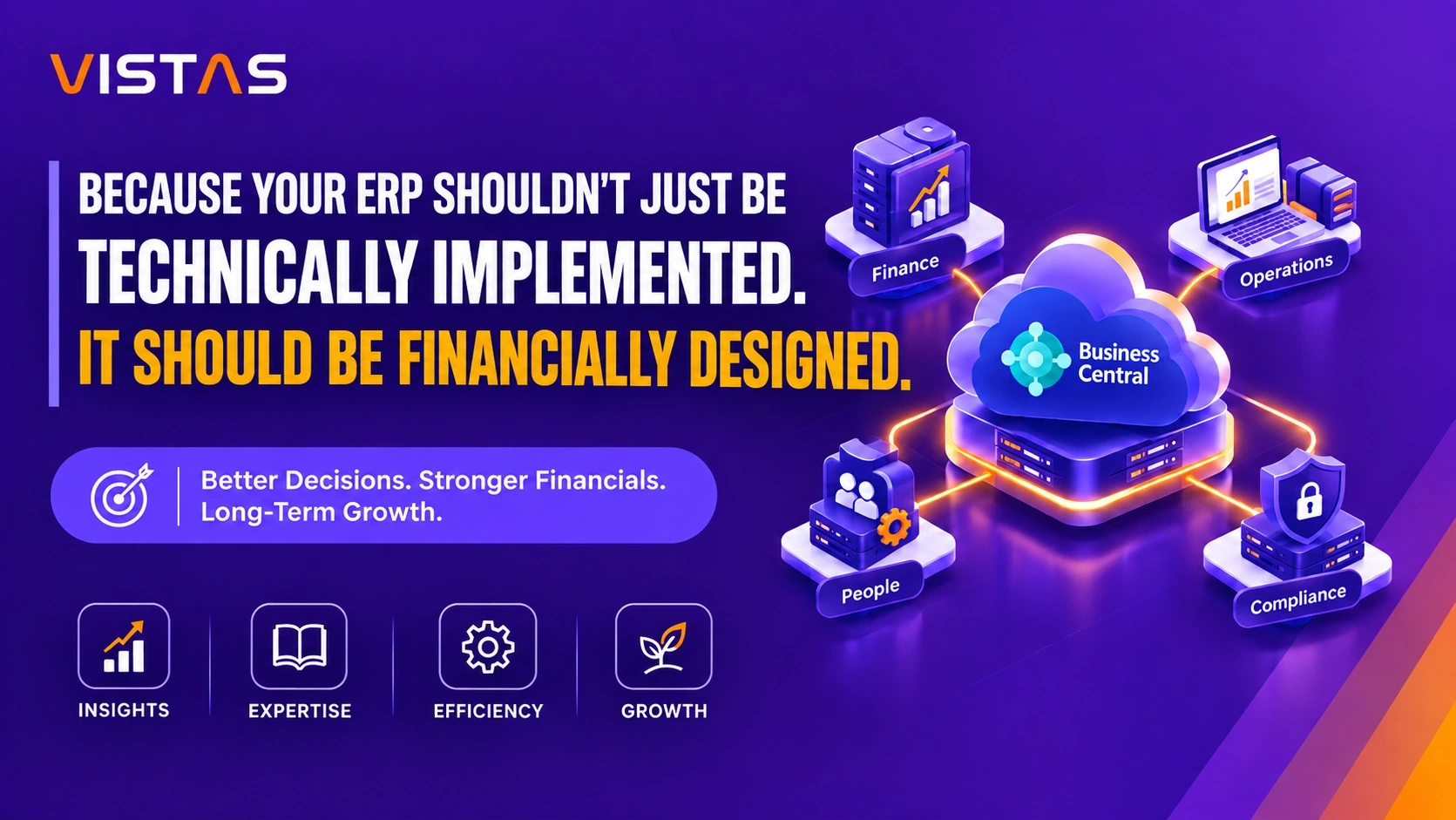
Because your ERP shouldn’t just be technically implemented. It should be financially designed.
FAQs
What is Microsoft Dynamics 365 Business Central?
Microsoft Dynamics 365 Business Central is an ERP solution that enables businesses to manage core operations like finance, sales, purchasing, inventory, projects, and more in one connected system.
Why is financial expertise important during Business Central implementation?
Business Central implementation involves decisions on chart of accounts, dimensions, posting structures, reporting, approvals, data migration and financial controls. Financial expertise is critical in ensuring that the ERP is configured around the organization’s accounting and reporting needs.
What does a Business Central implementation typically involve?
A Business Central implementation can include financial discovery, process analysis, system configuration, data migration, integrations, testing, user training and go-live support. The scope is based on the processes and needs of the organization.
Is Microsoft Dynamics 365 Business Central an ERP system?
Yeah. Microsoft Dynamics 365 Business Central is an ERP platform that brings together financial management and business processes such as sales, purchasing, inventory, projects, and supply chain activities.
When should a business consider implementing Business Central?
Businesses may consider Business Central if their existing accounting or ERP system no longer satisfies their reporting, operations, inventory, workflow, scalability, or integration needs. This is especially true when you begin to look outside the QuickBooks or Dynamics GP world.